
Crane operator certification is a third-party credential, usually from NCCCO, that proves you can safely operate a specific crane type. You complete accredited training, pass a written core and specialty exam, then pass a hands-on practical exam. OSHA requires it for most construction crane work, and it stays valid for five years.
A Comprehensive Guide for Individuals & Businesses
Operating a mobile crane is a highly skilled job that requires precision, safety awareness, and compliance with strict regulations. This guide breaks down the essential steps, requirements, and tips for a smooth and successful certification process.
To become a crane operator you must be at least 18 years old, meet the vision and medical fitness standards, and be able to read, write and understand safety instructions and load charts. From there you enroll in an accredited training program, pass the written Core and Specialty exams, pass the hands-on practical exam, and submit your application to the certifying body. What most people call a crane operator license is this NCCCO card - there is no federal license for cranes - and it is renewed every five years.
Most operators get there in a matter of weeks, not years. Formal training runs from a few days to several weeks depending on the crane type, and testing is usually scheduled right after. Many employers sponsor the whole process and arrange on-site training and group testing for their crews, while individuals can book a class at one of our dates and locations nationwide. Experience on the machine helps, but it is the written and practical exams that decide whether you are certified.
Start by deciding which crane you want to be certified on - mobile, swing cab, fixed cab, lattice boom, overhead or telehandler - because the Specialty exam is tied to that machine. Then enroll in crane operator training, study the load charts before class, practice on the crane type you will be tested on, and track your expiration date once your card arrives so your certification never lapses.
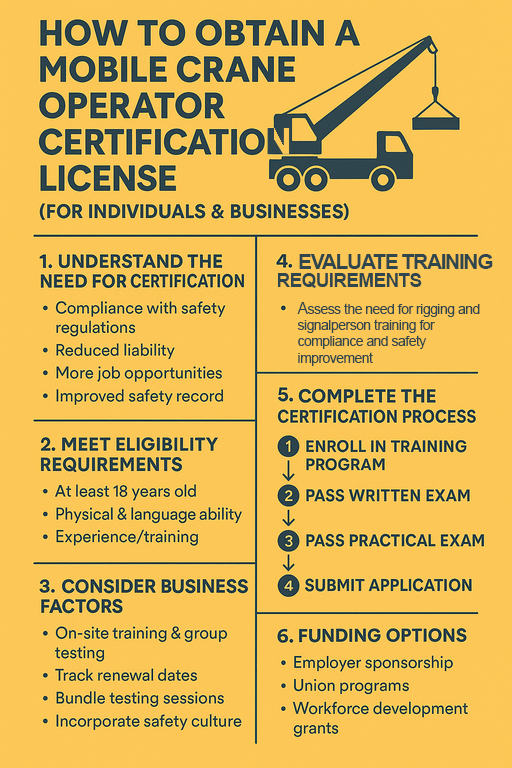
Certification is not merely a legal requirement in many regions-it is a fundamental safety necessity. In the U.S., the Occupational Safety and Health Administration (OSHA) mandates that most crane operators be certified by an accredited organization, such as the National Commission for the Certification of Crane Operators (NCCCO) or equivalent bodies. This critical step provides a multitude of benefits, ensuring not only legal compliance but also operational excellence and safety on the job site.
Before applying for certification, ensure you or your employees meet these fundamental criteria to qualify for the training and examination process.
Must be at least 18 years old to operate heavy machinery legally and safely.
Meet specific vision and medical fitness standards to ensure safe operation under all conditions.
Ability to read, write, and understand safety instructions and complex load charts.
While experience helps, formal training is highly recommended for comprehensive preparation.
If you are a business looking to certify your workforce, consider these strategies to streamline the process and maintain a high standard of safety:
If you are a business looking to certify your workforce, consider these strategies to streamline the process and maintain a high standard of safety:
Assess the need for rigging and signalperson training or compliance and safety improvement.
Select an accredited training provider with a proven track record of success. These programs typically last from a few days to several weeks and are crucial for building a strong foundation. Training covers essential theory, including understanding complex load charts, safety protocols, and signaling, as well as hands-on practical skills.
The written exam is comprised of a Core Exam, which tests general knowledge applicable to all crane types, and a Specialty Exam, focusing on the specific crane you intend to operate (e.g., mobile, tower, overhead). Key topics include:
This hands-on exam is where you demonstrate your ability to operate the crane safely and effectively. The test typically includes a series of maneuvers to assess your skill, such as:
After successfully completing both exams, you'll submit a formal application to the certifying body. This application will require proof of passing scores and may also include medical evaluation results to confirm your physical fitness for the job.
Most certifications are valid for 5 years. It is crucial to track your certification's expiration date. Recertification typically involves passing a new set of written and/or practical exams before the current certification lapses. Maintaining your status ensures you remain a qualified and compliant operator.
Certification is an investment. While costs vary, here's a general breakdown and potential funding sources:
Certification is an investment. While costs vary, here's a general breakdown and potential funding sources:
Load charts are a critical component of the written exam. Master them to ensure a passing score.
Familiarity with the machine you'll be tested on will significantly improve your practical exam performance.
Many training providers offer dedicated exam preparation sessions to help you pass with confidence.






An All Purpose Safety Training Solutions Company